The Authentic Recipe Test Misses the Point
The authentic recipe test misses how dishes change across households, migration and available ingredients. Learn to read a recipe as a living record.
The authentic recipe test misses how a dish changes from one household to another. A recipe may travel with a family, meet unfamiliar ingredients and settle into a new routine without losing its connection to the people who cook it. Instead of asking whether a version is the one true recipe, follow how its choices took shape.
A week of ordinary meals offers a useful way to practice. Choose a dish you know, keep a notebook nearby, and pay attention to the decisions behind it. The goal is not to crown a winner. It is to notice what a recipe preserves, what it adapts and what a cook considers essential.
What does an authentic recipe actually tell you?
A written recipe records one cook’s selection of ingredients, techniques and proportions at a particular moment. It may reflect a household habit, a local market, a holiday routine or the ingredients a writer could obtain. Its authority can come from careful documentation, but that does not make every other version false.
Food traditions are carried through practice as well as text. A family member may teach a dish by showing how the dough should feel or when a sauce smells ready. Those cues can be hard to capture in a printed recipe, yet they are part of how the dish is understood and repeated.
For the week, pick one dish with more than one version in your orbit: perhaps a relative’s bean soup, a neighborhood restaurant’s dumplings or a meal you make from a cookbook. Write down what you already believe makes it recognizable. Keep that note open to revision.
How can a dish change as it travels?
Migration changes the conditions of cooking. A household may arrive somewhere with different grains, vegetables, fats or cuts of meat. A cook can substitute what is accessible, learn from neighbors and adjust a familiar method to a different stove or schedule. Some changes are deliberate; others become routine because a particular ingredient is no longer easy to find.
These adaptations do not all mean the same thing. A substitution can preserve a dish’s structure, answer a dietary need, reflect a new local taste or simply make dinner possible. Ask what problem the change solves before judging whether it counts as faithful.
On the second day, look for a recipe’s likely constraints. Check its ingredient list against what is available where you live, and note any items that seem tied to a region or season. If you know the dish through family, ask a relative what they used when a listed ingredient was unavailable. Treat the answer as one account, not a rule for every household.
Which parts matter most to the people who cook it?
Not every ingredient carries equal weight. In one household, a particular spice may signal the dish; in another, the texture or serving ritual may matter more. A cook may accept a different vegetable while keeping the seasoning and method steady. Someone else may treat the vegetable as the defining feature.
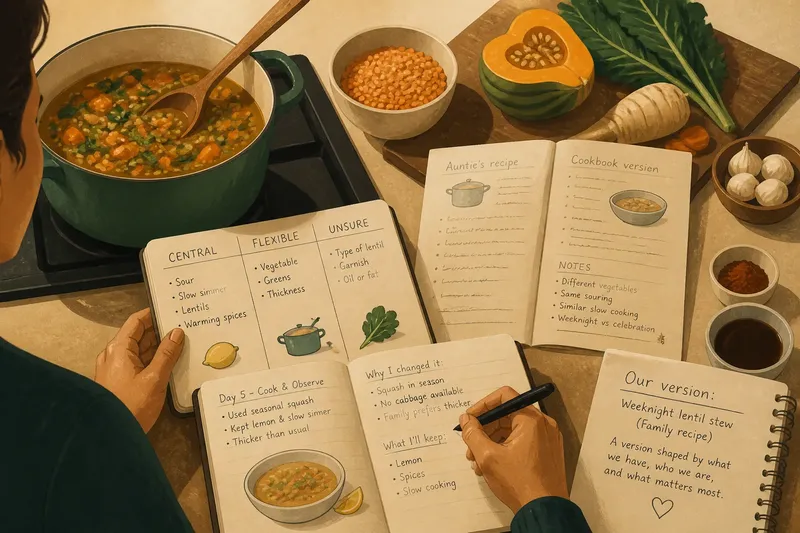
On the third day, separate your notes into three columns: what seems central, what seems flexible and what you are unsure about. Base the categories on the cooks’ own explanations, not on an imagined ranking of authenticity. If you are cooking from a book, mark the author’s stated purpose and distinguish it from your own assumptions.
Say you have a lentil stew recipe that calls for a vegetable your local shop does not carry. Imagine you use a familiar seasonal vegetable but keep the stew’s souring ingredient and slow simmer, because those are the features your family associates with the dish. The pot may look different, while the choices that make it recognizable to your household remain in place.
How should you compare versions without picking a winner?
Comparison works best when you ask what each version is doing. Put two recipes side by side and mark differences in ingredients, cooking order, texture and occasion. A weeknight version may be designed for speed; a celebration version may involve more hands and a longer preparation. Neither needs to stand in for every version.
On the fourth day, compare two sources for your chosen dish. They could be a family note and a cookbook, or two recipes from cooks with different backgrounds. Look for the circumstances each one describes. If a recipe offers no context, write that down rather than filling the gap with a claim about origin or authority.
- Note who taught or recorded each version, if known.
- Mark ingredients that are shared and ingredients that differ.
- Record any method or texture that both cooks emphasize.
- Ask what occasion or practical need each version serves.
- Leave unanswered questions visible instead of treating one source as definitive.
What questions help you read a recipe more carefully?
Can a recipe be authentic if an ingredient is substituted?
It can still belong to a meaningful household or community tradition. Note what the substitute changes and why the cook chose it, rather than treating every alteration as a loss.
Who gets to decide whether a version is authentic?
The answer depends on the dish and the people connected to it. A cookbook author can document a version, while cooks within a family or community may hold other knowledge and priorities.
How do you describe a dish with many versions?
Name the version and its context: for example, a family’s weekday preparation or a regional variation described by a particular cook. Specific wording is more useful than claiming to represent everyone.
Should you follow a recipe exactly?
Follow it closely when you want to understand that writer’s method, then note where your own ingredients or needs lead you elsewhere. If the directions concern food safety, use reliable guidance and the product’s instructions.
How can you keep the story with the recipe?
On the fifth day, cook the dish as one source describes it, if that fits your time and ingredients. Write down what you changed, what prompted each change and what you would keep next time. Describe observable details: whether the texture was loose or thick, which flavor stood out, and how the dish was served. Do not turn one meal into proof of a universal rule.
On the sixth day, share your notes with someone who knows the dish, if possible. Ask what sounds familiar and what differs from their experience. Listen for distinctions between personal preference and a claim about the whole tradition. A family recipe can be deeply important without speaking for every family.
Use the final day to revise the recipe’s heading and notes. Instead of labeling it simply “authentic,” give it a grounded description: whose version it is, where the recipe came from if known, and what substitutions you made. Keep uncertainty in the record when you cannot trace an ingredient or method.
The authentic recipe test misses the point when it treats change as evidence against a dish. A more useful record lets a recipe show its route: the household habits it carries, the ingredients it meets and the choices a cook makes today. That context helps the next person understand not just what goes in the pot, but why this version belongs at this table.