The Long Journey of the Tomato
The tomato’s journey from the Americas reshaped kitchens worldwide; see how cooks adapted it to local ingredients, techniques, and traditions.
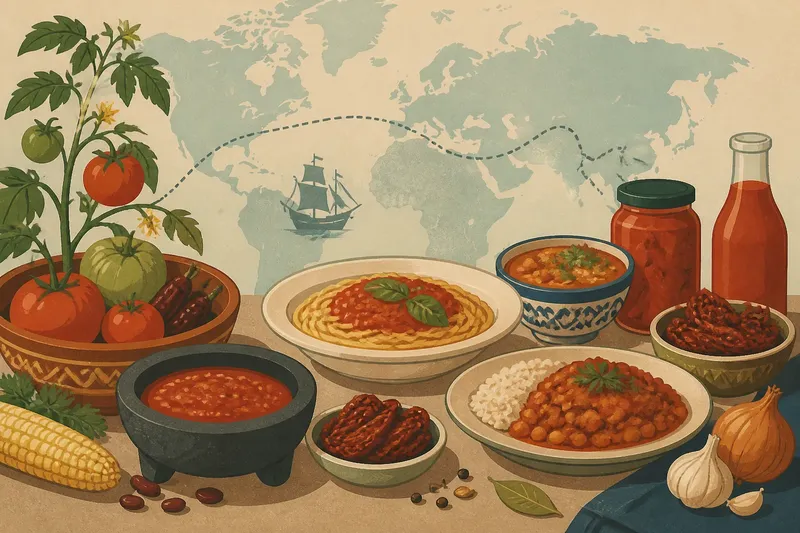
The tomato’s journey from the Americas changed what cooks could put in a pot, spread on bread, and serve beside a meal. Its arrival did not produce one universal tomato dish: cooks fitted the unfamiliar fruit to local ingredients, techniques, and tastes, with different results across places and periods.
That culinary history is a sequence of adjustments. A tomato could be a botanical curiosity, a cautiously regarded plant, a market ingredient, or the basis of a familiar sauce. These changing roles help explain why tomato traditions are varied—and why no single preparation can stand for them all.
Where did the tomato begin?
The tomato originates in the Americas. Indigenous peoples cultivated and used tomatoes in regions of Mesoamerica before the plant crossed the Atlantic. The English word “tomato” traces to a Nahuatl word, while the plant’s later culinary identity took shape through encounters among Indigenous foodways, European trade, and regional cuisines around the world.
Tomatoes were not a single uniform ingredient. Their forms and qualities varied, and cooks could use them fresh, crushed, or combined with other foods. In Mesoamerican cooking, tomatoes belonged to a broader food landscape that included chiles, maize, beans, herbs, and other ingredients. They were not simply waiting for European cooks to discover their purpose.
That distinction matters. The tomato’s global history is not a story in which European kitchens invented its value. It is a story of an established American food entering new routes of exchange, then being adapted and reinterpreted across continents.
Why did some European cooks hesitate?
After the Spanish arrival in the Americas, tomatoes crossed the Atlantic into European settings. Their reception varied by place and period: in some areas, people grew them as ornamental plants or approached them cautiously, while culinary uses developed gradually. Association with other plants in the nightshade family may have contributed to suspicion in some contexts, but it does not explain every response. Local food habits, knowledge, and access to the fruit also shaped whether people chose to eat it.
Seeing a fruit did not automatically tell a cook how to use it. Someone might encounter tomatoes in a garden or market without a familiar recipe, a trusted preparation, or a reason to serve them. Their soft texture and juicy interior also called for different handling from the firm fruits and roots that already had established kitchen roles.
Tomato use spread through regional cooking rather than through a single moment of acceptance. Cooks found roles for the fruit in dishes where its acidity, moisture, and savory flavor suited the other ingredients. Repeated use made it familiar in some kitchens, while its place and reception remained different elsewhere.
How did tomatoes become part of Italian cooking?
Italy became strongly associated with tomatoes, but that identity took shape through adoption and change. The tomato arrived from across the Atlantic; it was not an ancient ingredient in Italian cooking. Cooks gradually brought it into preparations using local foods, including pasta, bread, vegetables, oils, and cheeses.
Sauces offered an adaptable format. A tomato could be chopped and simmered with aromatics, cooked down to a thicker consistency, or combined with other ingredients. As cooks developed these uses, tomatoes became a recognizable element in many Italian food traditions. The result was not one national formula but a collection of regional approaches shaped by ingredients and household habits.
Say a cook in a coastal Italian town has a basket of ripe tomatoes, onions, and dried pasta but no established family sauce. She chops the tomatoes, softens the onions in oil, and simmers the mixture before dressing the pasta. The expected result is a loose, bright sauce; simmering it longer would make it thicker and more concentrated. This invented situation shows how an unfamiliar ingredient can become part of a meal through ordinary kitchen decisions.
How did tomatoes enter other cuisines?
Tomatoes moved through trade and migration, entering kitchens in parts of Asia, Africa, and the Middle East as well as Europe. The ways cooks used them differed by place and period. In some kitchens, tomatoes paired with rice, pulses, or local vegetables; elsewhere they became ingredients in stews, relishes, broths, or cooked sauces. A shared ingredient or technique does not make the resulting dishes culturally interchangeable.
In South Asian cooking, tomatoes became useful in gravies and lentil dishes, where their moisture and tartness could balance spices and other ingredients. Across parts of West Asia and the Mediterranean, tomatoes joined preparations that might include eggplant, peppers, herbs, or grains. In cuisines where chile and tomato met, their combination could supply both heat and a rounded, tangy base. These are broad patterns, not fixed rules: regions contain distinct traditions, and households often have their own methods.
Tomatoes also took on different roles according to texture. A fresh tomato can add juicy contrast to a salad or accompaniment. A cooked tomato can blend into a sauce, stew, or soup. A concentrated or preserved form can bring tomato flavor to a dish when fresh tomatoes are not the intended ingredient. The culinary journey is visible not just in which dishes use tomatoes, but in the many ways cooks learned to handle them.
What changes when a tomato is cooked or preserved?
Cooking transforms the tomato’s texture and changes how it combines with other ingredients. Heat softens its flesh and allows its juices to mingle with fats, aromatics, and other foods. A brief cook can leave a fresher, sharper impression; a longer simmer can reduce liquid and make the flavor seem more integrated. The choice depends on the dish, not on a universal rule that one texture is better.
Preserving extends the tomato’s role beyond the setting in which fresh fruit is available. Drying removes much of its moisture and produces a concentrated ingredient with a chewy texture. Canning keeps tomatoes ready for soups, sauces, and stews. Fermentation and pickling, where used, bring different flavors and uses. Each method creates a distinct ingredient, so a preserved tomato will not always behave like a fresh one.
These changes help explain how tomatoes became useful in different kitchens. A fresh slice may be the point of a dish; a cooked-down base may support many other ingredients. Preservation makes a related flavor available in another form. Cooks have not merely repeated one tomato preparation around the world: they have made different ingredients from the same fruit.
What questions explain the tomato’s culinary journey?
Was the tomato always considered a vegetable?
In everyday cooking, people often treat tomatoes as vegetables because they appear in savory dishes. Botanically, a tomato is a fruit. Those descriptions answer different questions, and the culinary category usually matters more when deciding how to use one in a meal.
Did tomatoes spread from Italy to the rest of the world?
Italy developed influential tomato traditions, but the tomato’s movement was broader than a single country exporting a finished cuisine. The fruit traveled through global exchange, and cooks in many regions developed their own uses. Its history is better understood as many adaptations than as a one-way transfer from Italian kitchens.
Why do tomato sauces taste different from place to place?
Cooks choose different aromatics, fats, spices, textures, and cooking times according to the dish and local food traditions. A tomato sauce can be bright and loose, deeply cooked, chile-rich, or built around other ingredients. The word “sauce” describes a broad role, not one fixed flavor.
Does every traditional tomato dish use fresh tomatoes?
No. Fresh, canned, dried, and otherwise preserved tomatoes have different textures and levels of concentration, and each has its own place in cooking. A recipe’s intended form can be part of its character, so substitution may change the result.
How can you recognize the tomato’s history on a plate?
Start by noticing what the tomato does in the dish. Is it served raw, cooked into a base, or used as a bright accent? Does it provide most of the liquid, or does it cling to grains, bread, pasta, or vegetables? Those questions point to the cook’s choices, rather than treating “tomato dish” as a single category.
Then look at the ingredients around it. A tomato paired with maize or beans belongs to a different culinary conversation from one simmered with pasta or blended into a spiced lentil dish. Similar ingredients can meet in distinct traditions, while a shared technique does not erase their differences. Naming the context is more informative than calling a preparation universally authentic.
Finally, consider the tomato’s form. Fresh slices, a smooth cooked sauce, a chunky stew, and dried pieces each reveal a different practical use. That is the long journey in everyday form: a fruit with American origins, carried into new kitchens and made meaningful through the specific work of cooks. When you taste a tomato-based meal, ask what role the tomato plays—and what else in the dish shaped that role.